

A single administrative oversight can transform a world-class expedition into a costly legal entanglement. You've spent months tuning your gear and tracking the bite, yet the shifting landscape of Baja offshore fishing regulations remains a source of persistent anxiety. It's natural to worry about the distinction between an FMM and a fishing license, or the exact boundaries of the newly established Fishing Refuge Zones in the Boca del Alamo and Punta Pescadero corridor. You shouldn't have to choose between the thrill of the hunt and the security of total legal compliance.
This guide masters the legal essentials of fishing Mexican waters so you can focus on the rail, not the paperwork. We'll provide a definitive checklist of required documents, clarify the 2026 bag limits for bluefin tuna and marlin, and detail the specific regulations governing departures from San Diego. By the end of this article, you'll understand the point-based limit system and the recent protections surrounding Espíritu Santo National Park. You'll gain the confidence to lead your crew into the deep, knowing every permit is in place and every catch is within the law.
Key Takeaways
- Secure your Mexican Sportfishing License and FMM visa before departure to eliminate the risk of boat seizure or heavy fines.
- Navigate the current Baja offshore fishing regulations by mastering the point-based bag limit system for tuna, dorado, and billfish.
- Pinpoint the exact boundaries of the 2026 Fishing Refuge Zones to ensure your expedition stays clear of protected marine corridors.
- Streamline your San Diego to Baja journey with a clear checklist of consulate notifications and vessel manifest requirements.
- Discover how private charter crews handle the burden of international paperwork so you can focus entirely on the hunt.
Navigating Baja Offshore Fishing Regulations in 2026
Crossing the maritime border between the United States and Mexico is more than a change in scenery. It is a fundamental shift in legal jurisdiction. Understanding the Baja offshore fishing regulations is the first step toward a successful expedition. These rules are overseen by CONAPESCA, the National Commission of Aquaculture and Fisheries, which manages the vast marine resources of the Pacific and the Sea of Cortez. In 2026, their mandate has tightened to prioritize sustainable pelagic harvests, ensuring that these legendary grounds remain productive for generations to come. The ocean is vast, the fish are powerful, and the rules are absolute.
Current standards prioritize the health of the ecosystem over the volume of the harvest. The establishment of three new Fishing Refuge Zones in the Boca del Álamo–Punta Pescadero corridor in June 2026 highlights this shift. For private boaters, the legal consequences of drifting into these zones or ignoring permit requirements can be devastating. Non-compliance often results in heavy fines, the confiscation of gear, or the seizure of the vessel itself. Professional charters offer a significant advantage here. The captain and crew assume the responsibility for compliance, ensuring every drift and troll is legally sound. Strict adherence to Baja offshore fishing regulations ensures that your vessel remains on the water and out of the impound lot.
The 12-Mile vs. 200-Mile Limit
Understanding where your lines are in the water is vital for legal safety. Mexico claims 12 nautical miles from the coast as its territorial waters, while the Exclusive Economic Zone (EEZ) reaches out to 200 miles. Most Big-game fishing occurs within this EEZ, where specific reporting requirements apply the moment you cross the "line" from San Diego. Modern GPS technology has eliminated the gray zones of the past. Authorities now use real-time tracking and satellite monitoring to verify vessel locations with surgical precision. If you're on the water, you're on the radar.
Why Regulations Differ for Magdalena Bay
Magdalena Bay represents a unique regulatory environment that requires specialized knowledge. Because of the world-famous marlin run and the delicate mangrove systems, seasonal closures and restricted zones are strictly enforced. These aren't suggestions; they are vital tools for conservation. Navigating these nuances requires local expertise and a deep understanding of seasonal bans, such as those protecting the Catarina scallop or striped mullet. Professional crews who specialize in custom spearfishing trips in Baja bring the experience necessary to respect these boundaries while finding the fish. They handle the logistics, so you can focus on the strike.
Essential Documentation: Licenses, Visas, and Permits
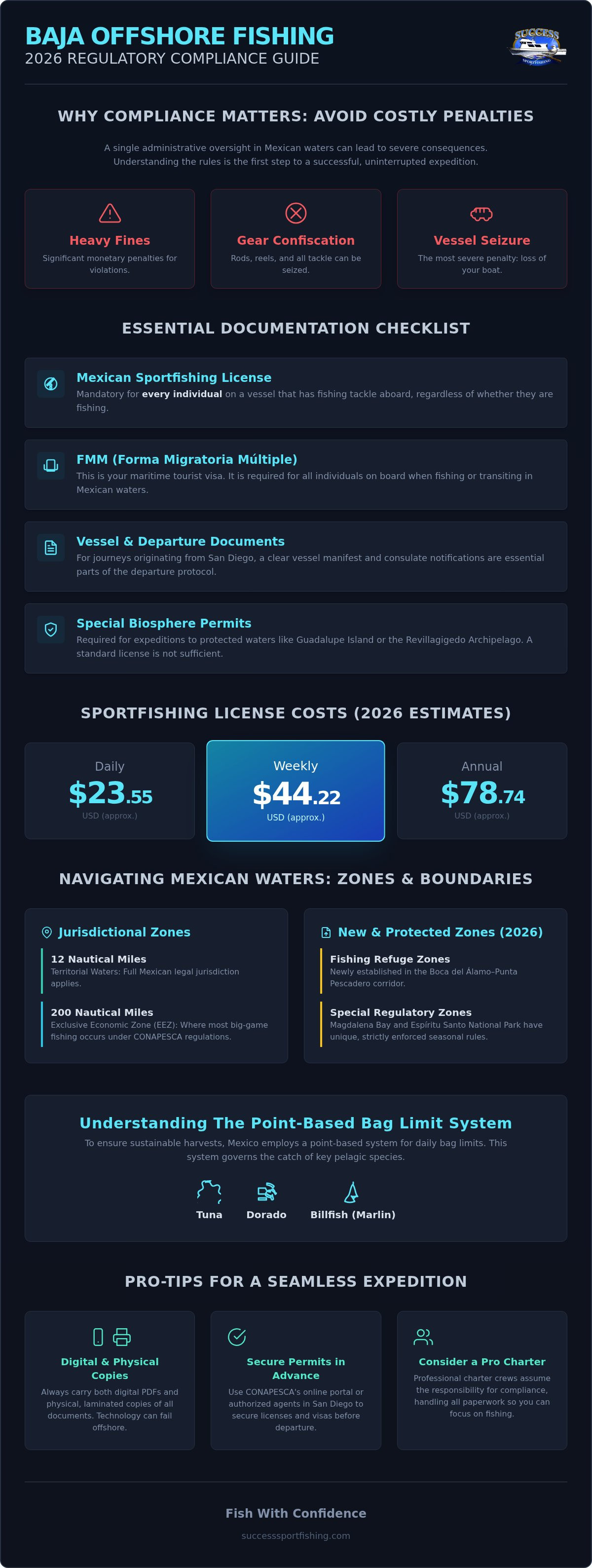
Proper documentation is the silent partner of every successful voyage. Under 2026 Baja offshore fishing regulations, the Mexican government has streamlined its digital portals, but enforcement remains rigorous. You must carry proof of your right to be in their waters and your right to harvest from them. Missing a single form can lead to immediate fines or the termination of your trip. It's a matter of professional preparation that separates the seasoned angler from the amateur.
Beyond the standard permits, certain expeditions require specialized access. If your hunt takes you to protected waters like Guadalupe or the Revillagigedo Archipelago, a standard license isn't enough. You'll need a specific Biosphere Reserve Permit. These permits support the conservation efforts that keep these destinations world-class. While Mexico has moved toward digital processing, smart captains carry both formats. Keep digital PDFs on your mobile device, but always have physical, laminated copies on the boat. Technology can fail in the middle of the Pacific; paper rarely does.
Securing Your Mexican Fishing License
Every individual on a vessel carrying fishing tackle must possess a valid Mexican Sportfishing License. This rule applies regardless of whether you intend to fish or are simply acting as a passenger. For 2026, costs are tiered to provide flexibility for different trip lengths. Daily licenses are approximately $23.55 USD, while weekly options cost around $44.22 USD. Dedicated anglers often choose the annual license at roughly $78.74 USD for year-round access. These can be secured via CONAPESCA’s online portal or through authorized agents in San Diego. It's vital to check the latest U.S. Embassy Fishing Advisory for any sudden changes in enforcement zones or permit requirements.
The FMM Maritime Visa Protocol
The Forma Migratoria Múltiple (FMM) is your maritime tourist visa. If you're fishing within 12 miles of the coast or visiting land, it's mandatory. For offshore expeditions, the 72-hour rule applies. If you're in Mexican waters for more than 72 hours, the FMM is a non-negotiable requirement. In 2026, the fee is $983 MXN, which is roughly $54 to $57 USD. Digital filing has simplified this process for San Diego departures, allowing you to submit your information and pay the fee before the lines are even cast. Navigating these requirements alone can be a distraction from the water. Choosing multi-day fishing charters ensures that your crew handles the permit verification, leaving you free to focus on the bite.
Species-Specific Rules and Protected Marine Zones
Mastery over the water requires more than a sharp hook and a heavy drag. It demands a precise understanding of the harvest. Baja offshore fishing regulations employ a sophisticated point-based system to manage daily bag limits. This isn't a simple count of heads; it's a weighted approach designed to protect apex predators while allowing for a bountiful return. Every angler is allotted 10 points per day. Balancing your catch within this limit ensures the sustainability of these legendary fisheries. The ocean is vast, the rules are specific, and the stakes are high.
Compliance doesn't end at the strike. It's illegal to fillet your catch on board the vessel. Mexican law requires that all fish remain whole or in a state where the species, size, and origin can be readily identified by inspectors. This is a critical detail for the return to San Diego. Professional crews provide high-end fish processing services once back at the dock, ensuring your harvest is handled with the same excellence that defined the hunt itself.
Tuna and Billfish: The 2026 Limits
Targeting the "Big Three" requires careful accounting. Marlin, sailfish, and swordfish are each worth five points, which effectively limits you to one of these trophy species per day. Dorado and roosterfish operate on a different scale; two of these fish equal five points, capping your take at two per day. Most other species, including yellowfin and bluefin tuna, are valued at one point each. You can retain up to five of the same species as long as your total daily tally doesn't exceed the 10-point threshold. This system prioritizes the longevity of the species while rewarding the skill of the angler.
Protected Zones and Biosphere Reserves
The map of Baja is dotted with sanctuary waters that demand absolute respect. The Pacific Islands Biosphere Reserve and the newly established Fishing Refuge Zones in the Boca del Álamo–Punta Pescadero corridor are strictly no-take areas. Dropping a line in these zones can lead to immediate vessel seizure. Expertly guided Magdalena Bay sportfishing trips utilize advanced GPS monitoring to navigate these boundaries with total precision. They ensure you're always on the right side of the law. This professional mastery allows you to hunt with a clear conscience, a focused mind, and total legal security.
The San Diego to Baja Departure Protocol
The transition from San Diego's Point Loma to the blue waters of Mexico is a calculated operation. It begins long before the engines turn over. To remain aligned with Baja offshore fishing regulations, you must notify the Mexican Consulate or the Port Captain of your intent to enter their waters. This pre-departure protocol is a formal acknowledgment of international law. It ensures your vessel is recognized as a legitimate sportfishing platform rather than a commercial intruder. In 2026, vessels over 14.5 feet must possess a Temporary Import Permit (TIP) and maintain an active Vessel Monitoring System (VMS). These systems provide a digital breadcrumb trail that confirms your adherence to protected zones and seasonal closures.
Returning to Point Loma requires just as much precision as the departure. Clearing U.S. Customs and Border Protection (CBP) is the final hurdle of any Baja run. You must present a clear, honest account of your time at sea. This includes verifying that all passengers have valid passports and that the vessel has maintained its legal status throughout the journey. Professional crews handle these reporting requirements as a matter of course, allowing you to transition from the hunt to the dock without administrative friction.
The Manifest and Gear Inventory
A comprehensive manifest is your strongest defense against customs delays and is a core part of staying compliant with Baja offshore fishing regulations. You must document every soul on board and every piece of specialized gear. When you're carrying premium tackle from Avet and Seeker, proof of prior ownership is essential for a smooth return. You don't want to pay import duties on gear you already owned. It's also vital to distinguish between "Take" and "Catch" when reporting to CBP. The "Take" refers specifically to the fish you are bringing back to the dock; the "Catch" includes everything handled and released. Maintaining these records with professional accuracy is a hallmark of an elite operation.
Communication at Sea
Maintaining contact with the Mexican Navy (SEMAR) is a requirement for safety and compliance. SEMAR patrols are frequent in high-activity areas, and they expect vessels to monitor specific hailing frequencies. Satellite communication is no longer a luxury for multi-day offshore trips; it's a mandatory lifeline for reporting and emergency coordination. If a boarding occurs, we advocate for the "Quiet Professional" approach. Be prepared, be polite, and have your documentation ready for immediate inspection. This level of readiness commands respect from international authorities. If you want an expedition where these logistics are handled with expert care, book one of our private sportfishing charters today.
Why Professional Charters are the Gold Standard for Compliance
Navigating the shifting tides of international law shouldn't be your concern when the tuna are boiling. For the elite angler, the priority is the hunt, the strike, and the harvest. Professional charters represent the gold standard for compliance because they shift the administrative burden from the guest to the seasoned expert. We manage the complex maze of Baja offshore fishing regulations so you can focus on the rail. From the initial manifest to the final customs clearance, every detail is handled with the quiet assurance of professional mastery. You deserve an expedition where the only thing you're tracking is the bite.
The burden of proof rests entirely with the vessel's operation. When you step onto a private charter, you're stepping into a pre-vetted environment where the boat permits, satellite monitoring, and reporting protocols are already in place. Our expertise extends to custom spearfishing trips in Baja, where specialized gear laws and species restrictions are even more stringent. We provide the top-tier gear, the seasoned crew, and the legal peace of mind required for a world-class journey. Success Sport Fishing brings decades of maritime experience to every voyage, ensuring that your time in Mexican waters is defined by excellence, not red tape.
The Crew’s Role in Your Legal Safety
Our captains monitor regulatory shifts in real-time, adapting to new Baja offshore fishing regulations as they are announced. We handle all Port Captain interactions and paperwork, shielding you from the friction of international bureaucracy. Beyond the permits, we ensure that every fish is processed according to international law. This means your catch is handled, stored, and documented correctly for a seamless return to Point Loma. It is a comprehensive approach to safety that covers you from the moment we leave the dock until the final fillet is processed.
Booking Your Baja Expedition
Private charters offer a level of flexibility and security that walk-on boats simply can't match. Whether you're customizing a trip to the marlin-rich waters of Magdalena Bay or scouting the Outer Banks, we tailor the journey to your specific goals. You get the grit of a traditional operator combined with the refined service of a modern luxury brand. Don't leave your legal standing to chance on a crowded deck. Contact us to book your premium, compliant adventure and experience the pinnacle of West Coast sportfishing.
Cast Your Lines with Total Confidence
Baja's waters offer some of the most legendary sportfishing on the planet, but the reward requires deep respect for the rules. Mastering the 2026 Baja offshore fishing regulations is the difference between a triumphant return and a logistical nightmare. You've learned about the mandatory FMM visas, the precise 10-point daily bag limit system, and the critical importance of staying clear of newly established Fishing Refuge Zones. These details shouldn't weigh on your mind when a massive school is boiling under the boat.
Success Sport Fishing stands as Point Loma's premier multi-day specialist, providing a seamless bridge between San Diego and the deep. We handle all-inclusive Baja logistics, from vessel manifests to professional fish processing, so you can focus on the fight. With premium Avet and Seeker gear at your disposal, you're equipped for peak performance during every strike. Secure Your Private Baja Charter with Success Sport Fishing and leave the paperwork at the dock. The horizon is calling, and we're ready to lead the way.
Frequently Asked Questions
Do I need a Mexican fishing license if I am just watching and not fishing?
Yes, every person on a vessel carrying fishing tackle must have a valid Mexican fishing license, even if they aren't actively fishing. This regulation applies to passengers, observers, and crews alike. Mexican authorities consider the presence of gear on the boat as intent to fish for everyone on board. When departing from Point Loma, our crew verifies that every guest has the correct documentation to avoid legal complications during inspections.
How much does a Mexican sportfishing license cost in 2026?
In 2026, the approximate costs for a Mexican sportfishing license are $23.55 USD for a daily permit, $44.22 USD for a weekly permit, and $78.74 USD for an annual license. These fees are subject to exchange rate fluctuations and are separate from any charter booking fees. We recommend the annual option for regular anglers who frequent the Baja grounds. It's the most cost-effective way to stay compliant with Baja offshore fishing regulations throughout the season.
Can I bring my catch back to San Diego from Baja?
You can absolutely bring your catch back to San Diego, provided it's processed according to both Mexican and U.S. laws. Fish must remain whole or in a state where the species and size are identifiable until you reach the dock. Once we return to Point Loma, professional fish processing services are available to handle your harvest. You'll also need to declare your "Take" to U.S. Customs and Border Protection upon re-entry to the United States.
What is the "72-hour rule" for FMM visas in Mexico?
The 72-hour rule dictates that any angler staying in Mexican waters for more than 72 hours must possess a valid Forma Migratoria Múltiple (FMM). This maritime tourist visa is also required if the vessel enters within 12 miles of the coastline or makes port. For shorter offshore trips that remain in the Exclusive Economic Zone, the requirement can vary. We ensure all guests on our multi-day expeditions have their FMM digital filings completed before leaving San Diego.
Are there specific areas in Baja where fishing is completely banned?
Yes, several "no-take" zones exist where fishing is strictly prohibited to support marine conservation. These include the newly established Fishing Refuge Zones in the Boca del Álamo corridor and specific areas within the Pacific Islands Biosphere Reserve. Dropping a line in these protected zones can result in immediate vessel seizure and heavy fines. Our captains use advanced GPS monitoring to stay well outside these boundaries, ensuring your trip remains entirely within legal waters.
What happens if a Mexican Navy vessel boards our charter boat?
If a Mexican Navy (SEMAR) vessel boards the boat, the crew handles all primary communication and documentation checks. Boardings are a routine part of maritime enforcement in Baja and are usually quick if all paperwork is in order. You'll be asked to show your passport and fishing license while the officers verify the vessel's manifest. We maintain a professional, cooperative environment to ensure these inspections are a minor pause in your fishing day rather than a disruption.
Do I need a passport to fish offshore in Baja?
A valid U.S. passport book or passport card is a mandatory requirement for all offshore fishing trips into Mexican waters. Even if you don't plan to step foot on land, you're entering a foreign jurisdiction that requires proof of citizenship for re-entry into the United States. Before we depart from Point Loma, we verify that every passenger has their passport ready. This ensures a smooth process when clearing U.S. Customs and Border Protection at the end of the run.
How do bag limits work on a 3-day or 5-day multi-day trip?
On multi-day trips, bag limits are cumulative based on the number of days spent fishing, up to a maximum of three daily limits. For a five-day trip, you're legally allowed to retain three days' worth of fish, provided you can prove the duration of your stay. This is where a professional manifest and captain's log are essential. We help you track your points to stay within the Baja offshore fishing regulations, maximizing your harvest while remaining fully compliant.